The global steel industry is undergoing a quiet but profound transformation in how it tackles one of metallurgy's oldest challenges: oxygen removal from molten steel. Traditional single-element deoxidizers like aluminum or ferrosilicon have long dominated the landscape, but a new generation of complex deoxidizers — particularly silicon-manganese (Si-Mn) and calcium-silicon (CaSi) alloys — is rapidly redefining expectations for cleanliness, mechanical performance, and cost-efficiency.
Why the shift? Because modern steel applications — from automotive advanced high-strength steels (AHSS) to offshore wind turbine components — demand unprecedented levels of inclusion control and ductility. Complex deoxidizers not only lower total oxygen content but also modify inclusion morphology, transforming sharp, brittle alumina clusters into harmless, globular calcium aluminates. This article explores the science, real-world performance, and emerging trends driving the adoption of complex deoxidizers.
Why Traditional Deoxidation Falls Short
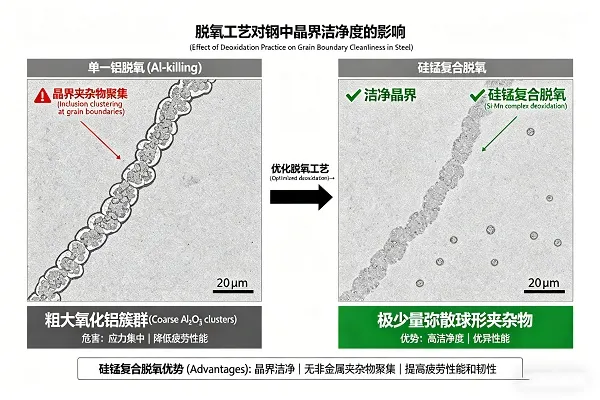
Conventional deoxidation using aluminum or silicon alone effectively removes dissolved oxygen, but often leaves behind detrimental solid inclusions. Aluminum deoxidation produces Al₂O₃ inclusions — hard, angular particles that reduce fatigue life and machinability. Silicon-only deoxidation generates glassy silicates that can deform during rolling but still impair surface quality. The industry has recognized that multi-component thermodynamics offer a superior path: combining silicon, manganese, and calcium yields lower oxygen activity and forms liquid or globular inclusions at steelmaking temperatures.
Rise of Silicon-Manganese (Si-Mn) as a Workhorse
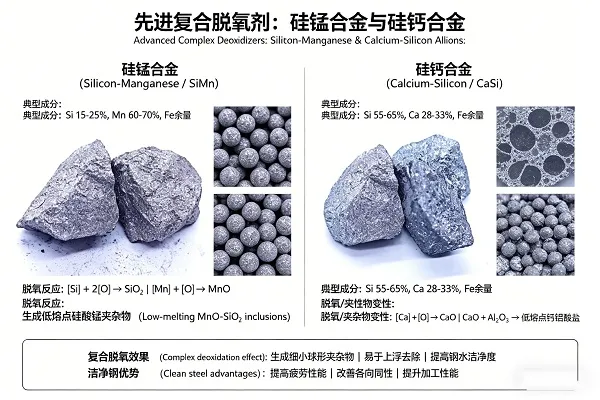
Silicon-manganese alloy (typically 65-70% Mn, 16-20% Si) has become a preferred pre-deoxidizer and final deoxidizer in many meltshops. The synergistic effect arises because manganese enhances the deoxidation power of silicon by forming a MnO-SiO₂ liquid phase that readily floats out of the steel bath. Modern ladle metallurgy practices using Si-Mn achieve total oxygen levels below 15 ppm — levels once thought impossible without vacuum degassing. Furthermore, Si-Mn reduces alloy cost compared to using separate ferrosilicon and manganese additions, streamlining inventory and dosing.
Calcium-Silicon (CaSi): The Game Changer for Inclusion Engineering
While Si-Mn excels at bulk deoxidation, calcium-silicon alloys are the ultimate tool for inclusion modification. Calcium has a very high affinity for both oxygen and sulfur; when added as a cored wire or lump alloy, it converts solid Al₂O₃ inclusions into low-melting-point calcium aluminates (e.g., 12CaO·7Al₂O₃). These globular inclusions are far less harmful to mechanical properties and often improve machinability. Modern steelmakers increasingly combine a Si-Mn base treatment followed by a precise CaSi cored wire injection to achieve optimal cleanliness, especially in continuous casting grades where nozzle clogging must be avoided.
Comparative Performance at a Glance
| Deoxidation Method | Typical Total Oxygen (ppm) | Inclusion Morphology | Relative Cost |
|---|---|---|---|
| Aluminum (Al) only | 20-30 | Sharp, angular Al₂O₃ clusters | Low |
| Ferrosilicon (FeSi) | 35-50 | Brittle silicates | Low-Medium |
| Si-Mn Complex | 12-18 | Liquid MnO-SiO₂, easy removal | Medium |
| CaSi + Si-Mn | 8-12 | Globular calcium aluminates | Medium-High |
Industrial Case: High-Grade Pipeline Steel Upgrade
A prominent North American plate mill producing API X70 grade pipeline steel faced persistent issues with hydrogen-induced cracking (HIC) and low Charpy impact values. After switching from conventional aluminum deoxidation to a two-step practice (Si-Mn pre-deoxidation + CaSi cored wire injection), the mill reported a 45% reduction in inclusion rating and passed HIC tests with zero cracks. Additionally, the calcium treatment improved castability, extending tundish life by 18%. This case illustrates why complex deoxidizers are becoming standard for critical linepipe and structural grades.
Sustainability and Cost Synergies
Beyond quality, complex deoxidizers support the industry's decarbonization goals. By reducing the need for rework and scrap due to inclusion defects, overall energy consumption per ton decreases. Moreover, Si-Mn and CaSi alloys enable the use of lower-grade ferrous scrap because the deoxidation practice can compensate for residual elements. With electric arc furnace (EAF) steelmaking expanding, the flexibility of complex deoxidizers aligns perfectly with circular economy models. Bright Alloys' new generation of high-density Si-Mn briquettes further improves recovery rates and reduces dust generation compared to traditional lumpy alloys.
Looking Ahead: AI-Optimized Deoxidation & Novel Compositions
The next frontier involves AI-assisted dynamic models that predict optimal complex deoxidizer additions in real-time based on oxygen activity, temperature, and steel grade. Additionally, researchers are exploring low-titanium Si-Mn and calcium-silicon alloys with trace rare earth elements (Ce, La) to further refine inclusion control. As sustainability mandates tighten, expect complex deoxidizers to become the default in high-quality steel segments. For foundries and steel mills, partnering with an experienced ferroalloy supplier like Bright Alloys ensures access to consistent chemistry, technical support, and the latest innovations in deoxidation metallurgy.
Embracing complex deoxidizers isn't just a technical upgrade — it's a strategic move toward superior product performance and operational excellence. Whether you produce automotive sheets, heavy plates, or specialty bars, silicon-manganese and calcium-silicon alloys offer a proven path to cleaner, stronger, and more reliable steel.