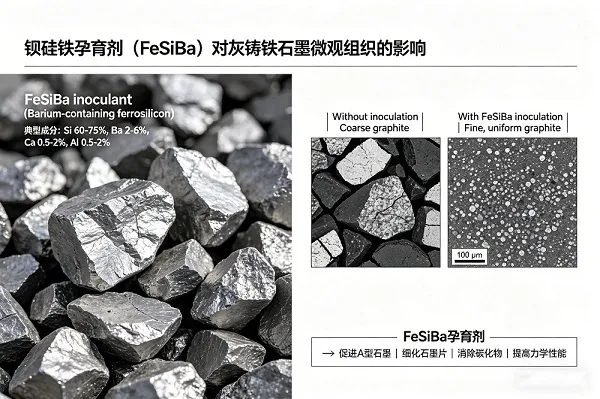
For gray iron foundries seeking consistent Type A graphite, elimination of chill in thin sections, and extended holding times without fading, barium-containing ferrosilicon inoculants (FeSiBa) represent a significant advancement over standard ferrosilicon. Barium is not merely a substitute for calcium — it offers distinct metallurgical advantages that address the most persistent challenges in gray iron casting.
This article examines the science behind barium's superior nucleation potency, its remarkable fade resistance, and the practical benefits that have made FeSiBa the inoculant of choice for demanding gray iron applications — particularly thin-wall castings, complex geometries, and long-pour sequences.
The Challenge: Limitations of Standard Ferrosilicon Inoculation
Standard 75% ferrosilicon (FeSi) inoculant has been the foundry workhorse for decades. However, its limitations are well-documented:
- Rapid fade: Nucleation sites begin disappearing within 5–8 minutes after addition, requiring casting to occur quickly
- Poor chill control in thin sections: Wall thicknesses below 6 mm often exhibit Type D/E graphite or carbide formation
- Limited shrinkage feeding: Minimal graphite expansion during solidification
- Section sensitivity: Significant property variation between thick and thin casting regions
Barium-containing inoculants directly address each of these limitations through unique nucleation chemistry and extended stability.
The Mechanism: How Barium Enhances Nucleation
Inoculation effectiveness depends on the number and stability of graphite nucleation substrates. Barium contributes through multiple mechanisms:
1. Formation of Stable Nucleation Compounds
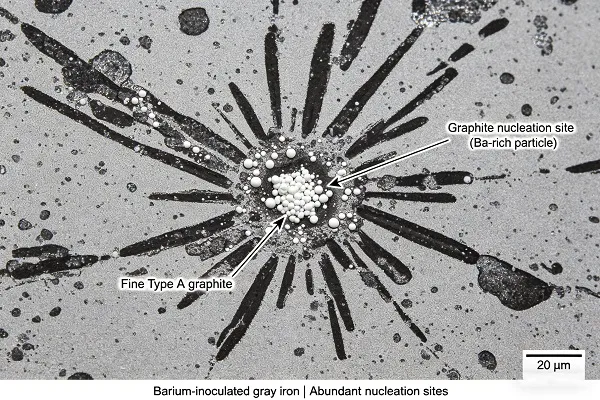
Barium in the inoculant (typically 1–6% Ba) forms highly stable compounds that act as potent graphite nucleation sites:
- Barium oxide (BaO): Forms stable, fine dispersions with excellent crystallographic matching to graphite
- Barium sulfide (BaS): Particularly effective in irons with moderate sulfur levels (0.05–0.10% S)
- Barium aluminosilicates (BaAl₂Si₂): Complex refractory compounds with high thermal stability
These barium compounds remain stable at higher temperatures than calcium-based nucleation sites, providing greater nucleation density and resistance to dissolution.
2. Lower Surface Tension, Better Dispersion
Barium reduces the surface tension of molten iron, allowing inoculant particles to disperse more uniformly throughout the melt. The result: more nucleation sites distributed evenly, reducing the tendency for localized chill or Type B graphite rosettes.
Fade Resistance: The Game-Changing Advantage
The most operationally significant benefit of barium inoculants is extended fade resistance. Fade is the progressive loss of nucleation sites over time due to dissolution, agglomeration, and oxidation. Comparative data shows:
| Inoculant Type | Initial Chill Reduction | Chill Depth After 5 min | Chill Depth After 10 min | Chill Depth After 15 min |
|---|---|---|---|---|
| Standard FeSi (75%) | Excellent | Moderate increase | Severe increase | Inoculation lost |
| FeSiBa (Ba 1-2%) | Superior | Minimal increase | Moderate increase | Still effective |
| FeSiBa (Ba 2-4%) | Superior | Virtually unchanged | Minimal increase | Good protection |
| FeSiBa (Ba 4-6%) | Exceptional | No measurable change | Slight increase | Significant protection remaining |
Practical implication: With standard FeSi, casting must be completed within 5–8 minutes of inoculation. With FeSiBa (2-4% Ba), foundries have 15–20 minutes of fade-resistant window, enabling larger ladles, multiple mold pours, and more flexible production scheduling.
Chill Elimination in Thin Sections
Thin-section castings (3–8 mm wall thickness) are most vulnerable to chill — hard, brittle iron carbides that destroy machinability. Barium inoculants excel in chill control for three reasons:
- Higher nucleation density: More graphite sites per unit volume mean graphite can precipitate even under rapid cooling conditions
- Lower undercooling requirement: Barium compounds catalyze graphite precipitation at higher temperatures (less undercooling needed), preventing the temperature drop that leads to carbide formation
- Synergy with sulfur: In irons with 0.06–0.10% S, BaS formation is particularly beneficial for chill control in thin sections
Foundry data consistently shows 40–60% reduction in chill depth when switching from FeSi to FeSiBa (2-4% Ba) in thin-section gray iron castings, often allowing elimination of section-specific chills that were previously required.
Shrinkage Reduction Through Graphite Expansion
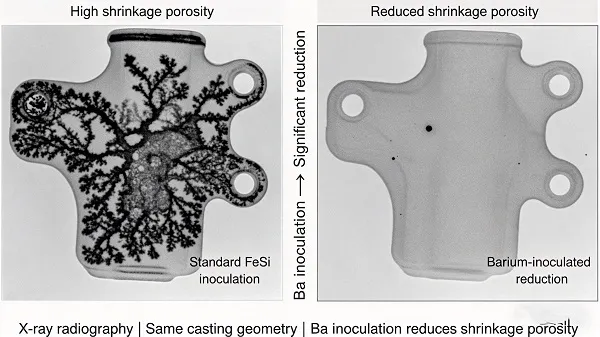
Shrinkage porosity in gray iron occurs when liquid contraction exceeds the compensating expansion from graphite precipitation. Barium inoculants enhance shrinkage resistance through:
- Delayed graphite precipitation: Barium shifts the onset of graphite expansion later in the solidification sequence, when more liquid contraction has already occurred — meaning more expansion is available to feed shrinkage
- Increased expansion volume: Higher graphite nucleation density results in more total graphite volume, increasing expansion
- Narrower solidification range: Barium promotes more eutectic solidification, reducing the mushy zone where shrinkage is most problematic
Foundries reporting before/after comparisons document 20–40% reduction in riser size requirements when switching from FeSi to FeSiBa, along with significant reductions in internal shrinkage rejection rates.
Selecting the Right Barium Level: 1-2%, 2-4%, or 4-6% Ba
Bright Alloys offers FeSiBa inoculants with three barium ranges, each optimized for specific applications:
| Grade | Barium Content | Best Applications | Key Benefits |
|---|---|---|---|
| FeSiBa 1-2% | 1.0–2.0% Ba | General gray iron, moderate section thickness (8–20 mm), shorter holding times | Good fade resistance (10–12 min), moderate chill control, cost-effective upgrade from FeSi |
| FeSiBa 2-4% | 2.0–4.0% Ba | Thin-wall castings (4–10 mm), extended pour sequences, shrinkage-prone designs, heavy-section castings with long solidification times | Excellent fade resistance (15–20 min), superior chill elimination, significant shrinkage reduction — most popular grade |
| FeSiBa 4-6% | 4.0–6.0% Ba | Extremely thin walls (3–6 mm), very long holding times (20+ min), complex castings with variable section thickness, high-quality standards | Maximum fade resistance (20–25 min), exceptional chill control, premium performance for critical applications |
Note that higher barium levels require slightly higher addition rates to achieve equivalent silicon contribution, but the barium-specific benefits justify the incremental cost for demanding applications.
Application Guidelines: Ladle, Stream, and Mold Inoculation
FeSiBa inoculants are versatile and effective across all inoculation methods:
Ladle Inoculation
Add 0.2–0.4% FeSiBa to the ladle during tapping. The extended fade resistance of barium ensures effectiveness even with moderate holding times. For large ladles (> 500 kg), use the higher end of the range.
Stream (Late) Inoculation — Preferred Method
Add 0.1–0.2% FeSiBa to the metal stream during pouring. This method maximizes barium efficiency, minimizes fading, and allows lower addition rates. For thin-section castings (< 6 mm), target 0.15–0.25%.
Mold (In-Mold) Inoculation
Place 0.05–0.15% FeSiBa (as fine granules or preformed blocks) in the gating system. Zero fade, lowest addition rates, ideal for automated high-production lines. Barium's stability ensures consistent dissolution even with variable pour speeds.
Case Example: Thin-Wall Pump Housing
A foundry producing gray iron pump housings with 5 mm wall sections struggled with chill-related rejections at 18%. Using standard FeSi ladle inoculation (0.35% addition), they still observed Type D graphite in critical areas. After switching to FeSiBa (2-4% Ba) with stream inoculation at 0.18%, results were dramatic:
- Chill depth reduced from 0.8 mm to 0.1 mm (essentially eliminated)
- Consistent Type A graphite across all wall sections
- Rejection rate dropped from 18% to 3%
- Total inoculant cost decreased 12% (lower addition rate offset higher unit cost)
- Pouring schedule flexibility increased — no quality loss when pouring the last molds from a ladle
The foundry subsequently converted all gray iron production to FeSiBa inoculants, with annual savings exceeding $150,000 from reduced scrap alone.
Quality Control: Verifying Barium Inoculation Effectiveness
To ensure consistent performance from FeSiBa inoculants, implement these verification steps:
- Thermal analysis: Target recalescence undercooling (ΔT) < 3°C for barium-inoculated gray iron (versus < 5°C for FeSi)
- Chill wedge test: Regularly section wedge castings and measure chill depth — should be near zero with proper FeSiBa practice
- Microstructure examination: Verify Type A graphite with uniform distribution; nodule count should be 200–400/mm² for properly inoculated gray iron
- Check sulfur level: Barium performs best with 0.06–0.10% S in the base iron; very low sulfur irons may need sulfur addition to activate barium compounds
For gray iron foundries seeking to elevate quality, reduce scrap, and gain production flexibility, barium-containing inoculants offer a proven path forward. The superior nucleation potency, extended fade resistance (15–20 minutes versus 5–8 minutes for standard FeSi), and exceptional chill control in thin sections make FeSiBa the premium choice for demanding gray iron applications. Bright Alloys supplies FeSiBa inoculants in 1-2%, 2-4%, and 4-6% barium grades, with customized sizing for ladle, stream, or mold inoculation — backed by metallurgical support to optimize your foundry practice.