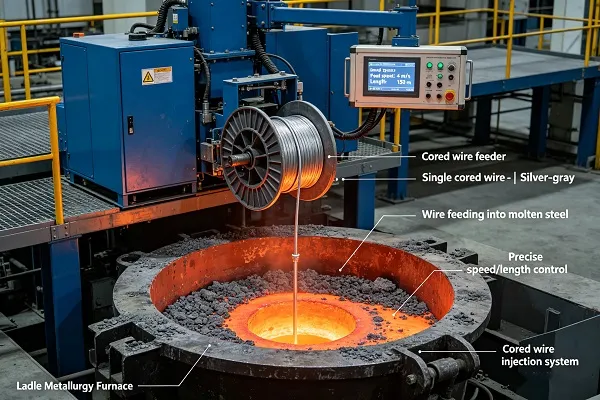
In modern ladle metallurgy, the method of alloy addition is just as critical as the alloy composition itself. Nowhere is this more evident than in calcium treatment — a process essential for modifying alumina inclusions and preventing nozzle clogging during continuous casting. While bulk calcium-silicon (CaSi) alloy additions have been used for decades, cored wire injection technology has emerged as the superior method, offering dramatically higher recovery rates, precise stoichiometric control, and consistent metallurgical results.
This article compares the efficiency, yield, and economic impact of calcium treatment via cored wire versus bulk alloy additions, providing practical guidance for steelmakers seeking to optimize their ladle metallurgy practices.
The Challenge: Calcium's Low Solubility and High Reactivity
Calcium is a powerful inclusion modifier but presents unique handling challenges. It has a low boiling point (1484°C) — below typical steelmaking temperatures — and a strong affinity for oxygen. When added in bulk form (lumps or crushed alloy), calcium tends to vaporize instantly upon contact with molten steel, resulting in violent reactions, poor penetration, and low recovery. Typical calcium recovery from bulk addition ranges from 5% to 15%, with much of the expensive alloy lost to fume and slag.
Cored wire technology overcomes these limitations by encapsulating calcium-containing powder (CaSi, CaFe, or pure Ca) inside a steel sheath. The wire is fed continuously through a guide tube deep into the molten steel bath, where the sheath melts and releases the reactive powder below the slag layer, minimizing exposure to air and slag oxidation.
Recovery Rates: The Decisive Advantage
The most compelling metric for comparing addition methods is calcium recovery — the percentage of added calcium that successfully modifies inclusions in the steel. Extensive industrial data show a stark contrast:
| Addition Method | Typical Calcium Recovery (%) | Variability (Std Dev) | Relative Cost per Effective Ca |
|---|---|---|---|
| Bulk CaSi (lump addition) | 8–15% | High (±5%) | Baseline (1.0x) |
| Cored wire (CaSi, 30% Ca) | 25–40% | Low (±3%) | 0.35–0.45x |
| Cored wire (CaFe, 30% Ca) | 30–45% | Low (±3%) | 0.30–0.40x |
| Pure calcium cored wire (97% Ca) | 35–55% | Very low (±4%) | 0.25–0.35x |
In practical terms, to achieve a target addition of 0.03% Ca in steel (typical for alumina modification), a bulk addition requires approximately 0.25–0.35 kg Ca per ton, while cored wire requires only 0.06–0.10 kg Ca per ton — a 60–70% reduction in calcium consumption.
Precision and Consistency: Eliminating Guesswork
Bulk addition suffers from inherent inconsistency. Lumps vary in size, dissolution time, and penetration depth. A single large lump may float on the slag, react with air, and contribute nothing to the steel. Smaller lumps may dissolve too quickly near the surface. The result is wide variation in final calcium content — from heat to heat and even within the same ladle.
Cored wire injection offers precise, repeatable feeding. Modern wire feeders control feed rate within ±1%, and the wire depth can be adjusted to release the alloy at the optimal zone (typically 1–2 meters below the slag surface). Operators can calculate the exact wire length needed based on steel weight, target calcium level, and expected recovery. This precision enables:
- Consistent Ca/Al ratios (0.10–0.15 target) for optimal inclusion modification
- Avoidance of over-treatment (which causes CaS formation and re-solidification issues)
- Elimination of under-treatment (which leaves harmful alumina clusters)
- Reduced need for chemical analysis rechecks and rework
Inclusion Modification: Quality Impact
The ultimate measure of calcium treatment is inclusion morphology. Effective treatment transforms solid, angular Al₂O₃ clusters into liquid or globular calcium aluminates (e.g., 12CaO·7Al₂O₃). Studies comparing bulk versus cored wire treatment on the same steel grade show:
- Bulk addition: Inconsistent modification; 30–50% of inclusions remain as undissolved alumina clusters. Nozzle clogging occurs in 10–20% of casts.
- Cored wire injection: Consistent modification; >90% of inclusions converted to globular calcium aluminates. Nozzle clogging reduced to <2% of casts.
For critical applications like tire cord steel, bearing steel, and automotive exposed panels, the reliability of cored wire treatment is not merely an economic advantage — it is an absolute requirement.
Operational and Safety Advantages
Beyond metallurgical performance, cored wire technology offers significant operational benefits:
- Reduced fume and dust: Bulk CaSi additions generate intense white fumes (calcium oxide) that challenge ventilation systems. Cored wire injection releases calcium below the slag, minimizing fume.
- Improved safety: Bulk additions can cause violent boiling and slag splashing. Cored wire feeding is controlled and predictable, reducing operator exposure.
- Lower slag carryover issues: Precise addition prevents excessive calcium from entering the slag, which would otherwise increase slag viscosity and cause refractory attack.
- Automation-ready: Modern wire feeders integrate with process control systems, enabling closed-loop adjustment based on real-time oxygen and temperature readings.

Types of Cored Wires for Calcium Treatment
Different applications require different cored wire compositions. Bright Alloys offers a full range:
| Cored Wire Type | Typical Composition | Best For | Recovery Range |
|---|---|---|---|
| CaSi Cored Wire | 28–32% Ca, 55–60% Si | Aluminum-killed steels, general inclusion modification | 25–40% |
| CaFe Cored Wire | 28–32% Ca, balance Fe | Lower silicon pickup, certain alloy grades | 30–45% |
| Pure Calcium Cored Wire | 97% Ca minimum | Ultra-low inclusion requirements, premium grades | 35–55% |
| CaSi + RE Cored Wire | Ca 28–30%, rare earths 1–3% | Enhanced inclusion modification, sulfur control | 30–45% |
Case Example: Converting from Bulk to Cored Wire
A North American mini-mill producing 500,000 tons per year of AHSS for automotive applications relied on bulk CaSi additions for calcium treatment. Their process suffered from inconsistent calcium recovery (10–18%), frequent nozzle clogging (12% of heats requiring tundish changes), and high alloy costs. After switching to CaSi cored wire injection with a target feed rate of 2.5 m/ton, the mill achieved:
- Calcium recovery increased to 32–38% (consistent)
- Nozzle clogging incidents reduced to 1.5% of heats
- Annual alloy cost savings: $480,000
- Reduction in tundish refractory consumption: 18%
- Improved customer acceptance rate for exposed automotive panels
The payback period for the wire feeder investment was less than six months.
Best Practices for Cored Wire Injection
To maximize the benefits of cored wire technology, follow these guidelines:
- Feed depth: Maintain 1.5–2.5 m below slag surface. Too shallow loses calcium to slag; too deep risks refractory contact.
- Feed rate: 2–5 m/s typical. Faster rates improve penetration but increase mechanical wear on guide tubes.
- Timing: Inject after deoxidation and argon stirring is established, but before final temperature adjustment.
- Slag condition: Ensure slag FeO < 2% and basicity > 2.5 for optimal recovery.
- Post-injection stirring: Maintain gentle argon stirring for 3–5 minutes to distribute calcium uniformly.
As steel cleanliness standards continue to tighten — driven by electric vehicle motor laminations, high-pressure hydrogen pipelines, and next-generation bearings — the precision and efficiency of cored wire injection will become even more critical. Steelmakers still using bulk calcium additions should evaluate the conversion; the metallurgical and economic case for cored wire has never been stronger. Bright Alloys supplies a complete range of cored wires (CaSi, CaFe, pure Ca, and custom formulations) backed by technical support to help optimize your ladle metallurgy practice.