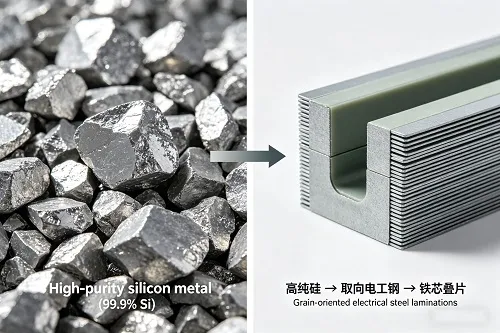
Electrical steels — both grain-oriented (GOES) for transformer cores and non-oriented (NOES) for motors and generators — represent the pinnacle of magnetic material engineering. Their performance hinges on a single, critical alloying element: silicon. Added as high-purity silicon metal (typically 98.5–99.5% Si), silicon transforms ordinary low-carbon steel into a material with dramatically improved magnetic properties. However, not just any silicon will do. Purity, particle size, and trace element control are decisive factors that separate premium electrical steels from commodity grades.
This article examines how silicon content and purity influence electrical resistivity, magnetostriction, core losses, and magnetic permeability — and why high-purity silicon metal (Grades 441, 553) is indispensable for modern electrical steel production.
Why Silicon? The Metallurgical Rationale
Pure iron has excellent magnetic saturation (2.15 T) but suffers from high eddy current losses and significant magnetostriction when exposed to alternating magnetic fields. Adding silicon addresses three fundamental challenges:
- Increases electrical resistivity — Silicon raises the electrical resistivity of iron from approximately 10 µΩ·cm to 45–60 µΩ·cm at 3% Si, drastically reducing eddy current losses.
- Reduces magnetostriction — Silicon minimizes dimensional changes during magnetization, lowering acoustic noise and further reducing hysteresis losses.
- Promotes favorable crystallographic texture — In grain-oriented steels, silicon enables the development of sharp Goss texture ({110}〈001〉), which aligns the easy magnetization direction with the rolling direction.
Optimal Silicon Content: Balancing Resistivity and Workability
Electrical steels typically contain 2.5% to 3.5% silicon, with some specialty grades reaching 4.5–6.5% Si (though higher Si levels make cold rolling extremely difficult). The relationship between silicon content and core loss (W/kg at 1.5 T, 50 Hz) is well-established:
- 0.5% Si: Core loss ≈ 4.5–5.0 W/kg — standard low-carbon steel
- 1.5% Si: Core loss ≈ 3.5–4.0 W/kg — entry-level electrical steel
- 2.5% Si: Core loss ≈ 2.2–2.8 W/kg — typical NOES for motors
- 3.2% Si: Core loss ≈ 1.0–1.5 W/kg — premium GOES for transformers
- 6.5% Si: Core loss ≈ 0.5–0.7 W/kg — ultra-low loss, but brittle (special processing)
The 3.0–3.3% Si range represents the sweet spot for grain-oriented electrical steels, offering optimal magnetic permeability (>1800) and core loss below 1.0 W/kg at 1.7 T for high-grade GOES (e.g., M-3, 27QG090 grades).

Purity Requirements: The Detrimental Role of Impurities
While silicon content determines the baseline magnetic performance, impurity levels in both the silicon metal and the final steel can degrade properties significantly. Critical impurities to control include:
| Impurity Element | Source | Effect on Magnetic Properties | Maximum Allowable (ppm) |
|---|---|---|---|
| Aluminum (Al) | Silicon metal / raw materials | Promotes abnormal grain growth, increases hysteresis loss | <100 |
| Carbon (C) | Steelmaking / silicon metal | Causes magnetic aging, increases core loss over time | <30 |
| Nitrogen (N) | Air entrainment / silicon metal | Forms AlN and other precipitates that pin grain boundaries | <20 |
| Sulfur (S) | Steelmaking / silicon metal | Forms MnS inclusions, disrupts Goss texture development | <30 |
| Titanium (Ti) | Silicon metal trace | Forms Ti(C,N) — extremely detrimental to grain growth | <20 |
This is why high-purity silicon metal (Grades 441, 553) is specified for electrical steel production. Grade 441 silicon metal typically contains:
- Si ≥ 99.0% (with some suppliers offering 99.2–99.5%)
- Fe ≤ 0.4%, Al ≤ 0.1%, Ca ≤ 0.01%
- Ti, C, P each < 0.01% (100 ppm)
Premium electrical steel producers often demand Grade 553 or custom-purified silicon metal with Al < 50 ppm and Ti < 20 ppm to achieve core losses below 0.9 W/kg in ultra-thin GOES (0.23 mm gauge).
Grain-Oriented vs. Non-Oriented Electrical Steels: Different Silicon Strategies
The role of silicon metal differs between the two main electrical steel families:
Grain-Oriented Electrical Steel (GOES): Used in transformer cores, GOES requires precise silicon control (2.8–3.4%) combined with inhibitor elements (MnS, AlN) to achieve secondary recrystallization and sharp Goss texture. High-purity silicon metal is essential because impurities disrupt the delicate inhibitor balance. Even 50 ppm of titanium can render the entire heat unusable for high-permeability GOES.
Non-Oriented Electrical Steel (NOES): Used in motor and generator laminations, NOES typically contains 2.0–3.2% Si. While purity requirements are slightly less stringent than GOES, modern high-efficiency motors (IE3, IE4 classes) demand consistently low inclusion levels. Here, silicon metal purity directly influences punching quality and interlaminar resistance.
Production Considerations: Addition Practices and Recovery
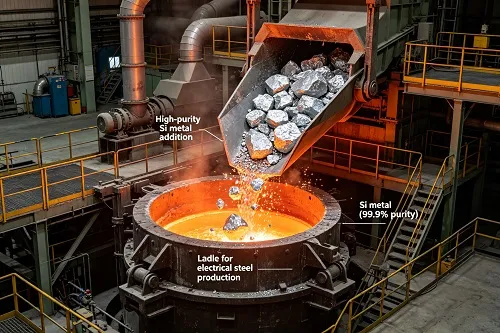
Silicon metal is typically added during the ladle metallurgy stage after preliminary deoxidation. Best practices include:
- Particle size: 10–50 mm lump silicon metal provides optimal dissolution without excessive dust formation.
- Recovery rates: Silicon recovery typically exceeds 90% when added to well-deoxidized steel with low slag FeO. Avoid adding silicon metal to highly oxidizing slags.
- Temperature control: Silicon dissolution is endothermic; compensate with superheat to avoid premature solidification.
- Segregation prevention: Ensure thorough stirring after addition to avoid silicon-rich pockets that cause property variations.
Case Study: Upgrading to High-Purity Silicon Metal for Premium GOES
A European electrical steel mill producing M-3 grade grain-oriented steel (0.27 mm thickness) experienced inconsistent core loss values ranging from 0.95 to 1.20 W/kg at 1.7 T, preventing them from achieving premium grade specifications. Root cause analysis traced variability to silicon metal purity: their standard 98.5% Si material contained 250–300 ppm Al and 50–60 ppm Ti. After switching to Grade 441 silicon metal (99.2% Si, Al < 80 ppm, Ti < 15 ppm), core loss stabilized at 0.92–0.98 W/kg, enabling qualification for high-efficiency transformer applications. The mill also reported improved secondary recrystallization consistency and a 15% reduction in reject rates due to abnormal grain growth.
The Growing Demand for High-Purity Silicon
With global regulations pushing toward higher efficiency transformers (DOE 2027 standards, EU Ecodesign Lot 5) and the rapid expansion of electric vehicle motor production, demand for premium electrical steels — and by extension, high-purity silicon metal — is accelerating. Bright Alloys supplies Grade 441, 553, and custom-purified silicon metal with certified low Al, Ti, and C levels, tailored to the stringent requirements of GOES and NOES producers. For electrical steel manufacturers, the choice of silicon metal is not a commodity decision — it is a strategic investment in magnetic performance and energy efficiency.